The Window Display That Still Reads After Closing
A window display that still reads after closing can carry its message through glare and changing light. Learn how to plan the transition and check it outside.
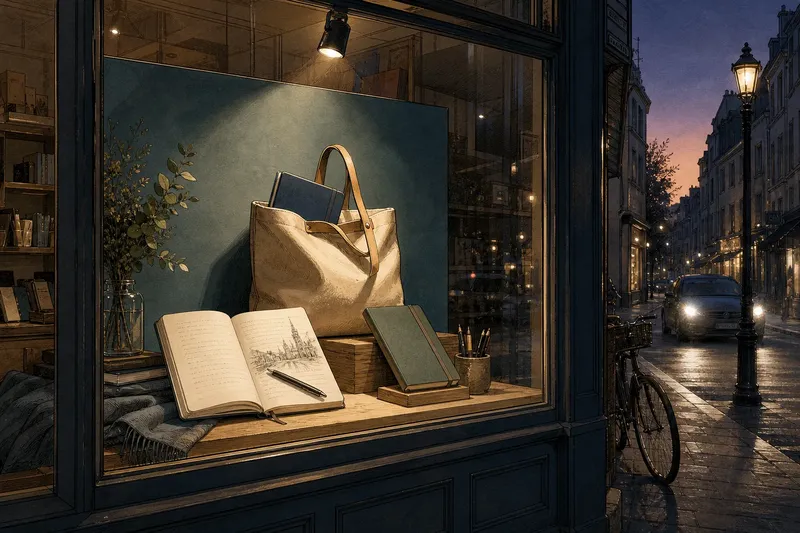
At dusk, the shop lights click off and a parked car’s headlights sweep across the glass. A window display that still reads after closing has to hold together through that change—not by showing every product detail, but by keeping its central idea visible from the sidewalk.
Say a fictional stationery shop on a narrow city street wants to feature hand-bound notebooks. Its invented starting point is a bright daytime arrangement that looks lively from inside but turns into a muddle at night. The owner’s aim is to suggest that the notebooks belong in a daily bag, using a setting that remains legible when the shop is closed.
What story can the objects tell without a sign?
Start with an action or setting, not a lineup of merchandise. A notebook partly tucked into a canvas tote suggests carrying; one opened on a counter suggests writing. The objects become a small scene rather than a row of covers waiting to be compared.
In the imagined shop, the owner sets an open notebook beside a tote, then places a closed one near the bag’s opening. The open pages suggest use, while the partly hidden cover connects the product to the tote. Instead of adding a stack of every available design, the owner chooses a few objects that support this single moment.
Think of arranging a shop window like setting a small stage: each object should belong to the same scene, even if it has a different role. A riser can suggest a counter; a folded cloth can hint at a travel bag’s contents. Props earn their place by making the scene easier to understand, not by filling empty space.
How can you build a scene that survives reflections?
Glass is a changing surface. At one angle, a passerby sees the display; at another, the window reflects streetlights, signs, or passing cars. A flat arrangement may look orderly from inside yet turn into overlapping shapes from outside.
Give the scene a clear front, middle, and back. In the stationery window, the open notebook sits forward, the tote stands behind it, and a matte blue-green panel creates a simple backdrop. The owner angles the tote so its opening and the notebook edge remain visible from the approach side. This arrangement communicates the setting through silhouette and position, rather than relying on small printed details.
Materials affect the scene, too. A matte painted board or uncoated paper can provide a quieter background than polished metal or glossy foil, which may catch stray reflections. The best choice depends on the storefront and its surroundings, so check how each surface behaves through the glass after dusk.
For the fictional shop, the owner first uses a pale wall behind the open notebook. In daylight, the white pages blend into it. After noticing this, the owner switches to the blue-green panel; the page edges stand apart, and the tote remains recognizable. The change makes the notebook scene easier to read without adding more stock.
What should you do when the daylight disappears?
Plan around the actual closing routine. If staff switch off the ceiling lights, a window that depends on them may go dark. A dedicated fixture can preserve the scene, but its placement matters as much as its brightness: aimed straight at the glass, a lamp can become a bright reflection for people outside.
In the imagined shop, the owner moves an adjustable fixture so it lights the open pages from above and slightly to the side. The beam avoids a white hotspot in the glass, while softer light still reveals the tote’s shape. The owner checks the view after the regular lights go off and changes the fixture angle when its reflection crosses the notebook.
Do not make every part of the scene equally bright. Light should help the viewer understand the setting: the page is visible, the tote gives context, and the background stays quiet. If the supporting objects disappear entirely, the notebook may look isolated; if everything glows, the scene loses its sense of depth.
What should you check from the sidewalk?
Walk out and look at the display from the direction people approach, then from directly in front. Repeat after the shop lights change. Each view can reveal a different problem: a reflection across the tote, a fixture visible in the glass, or a scene that looks like unrelated objects from farther away.
- Check the scene at dusk: If the setting becomes hard to recognize after the interior lights go off, adjust the window fixture or simplify the arrangement; if the setting remains clear, keep the lighting plan and check it again from the approach side.
- Check the glass from the approach side: If a streetlight or sign reflection covers the main objects, shift the display or adjust the fixture; if reflections fall outside the scene, leave the arrangement in place and inspect it from straight on.
- Check the backdrop behind each object: If an object’s outline blends into the panel, change the backdrop material or reposition the object; if the outline stays distinct, keep the combination and review it after dark.
- Check what the objects imply together: If the notebook and tote read as unrelated merchandise, turn or reposition them to suggest use; if they form a recognizable scene, avoid adding another prop that could distract.
- Check the fixture in the glass: If the lamp appears as a bright spot from outside, change its angle or add shielding; if the source stays out of view and the scene remains visible, retain its position.
- Check the scene after a passing light changes it: If headlights or streetlamps briefly erase the main shapes, move reflective materials out of the sightline or rearrange the objects; if the scene remains recognizable, keep the materials and note any routine cleaning they need.
Why should you check a window display after closing?
Does a window need its own light?
Not always. If the shop’s closing routine leaves the window visible, a separate fixture may be unnecessary; if the display fades when the interior lights go off, a dedicated, carefully aimed light can help preserve the scene.
Which background works best at night?
Choose a surface that separates the main objects from their surroundings without creating conspicuous glare. Matte board, fabric, or uncoated paper may work, but check the actual combination through the glass after dusk.
How many products should the scene include?
Include enough objects to make the setting understandable, then stop before the scene becomes a stock display. If each additional item strengthens the same visual story, it may belong; if it introduces a different story, leave it out.
Should a window display have a sign?
A sign can supply information the objects cannot, such as a product name or a short invitation to come inside. If the scene already communicates its purpose and the sign interrupts it, remove the sign or place it outside the main sightline.
How can a refresh preserve the same scene?
Imagine the stationery shop replacing the tote with a coat pocket for a seasonal display. The starting scene still uses the open notebook and blue-green backdrop; the owner moves the tote aside, props the notebook partly into the pocket, then checks the new arrangement from the sidewalk after dusk. If the notebook now reads as something carried in a coat, the setting has changed while the idea remains recognizable. If the pocket hides the pages, the owner turns it or removes it.
That kind of refresh is easier to judge by asking what the objects show together. A new prop should change or clarify the scene; a new backdrop should keep the materials distinct; a lighting adjustment should help the setting remain visible without turning the glass into a mirror.
A window display that still reads after closing is not necessarily one that shows every detail. It is one whose objects continue to suggest the same setting through reflections and changing light. Before leaving for the night, make one final sidewalk check from the approach side; a small change in angle can bring the whole scene back into view.