Build a Product Display Around a Customer’s Real Question
A product display built around a customer question helps shoppers compare options by need, use, and tradeoff—without hiding essential product details.
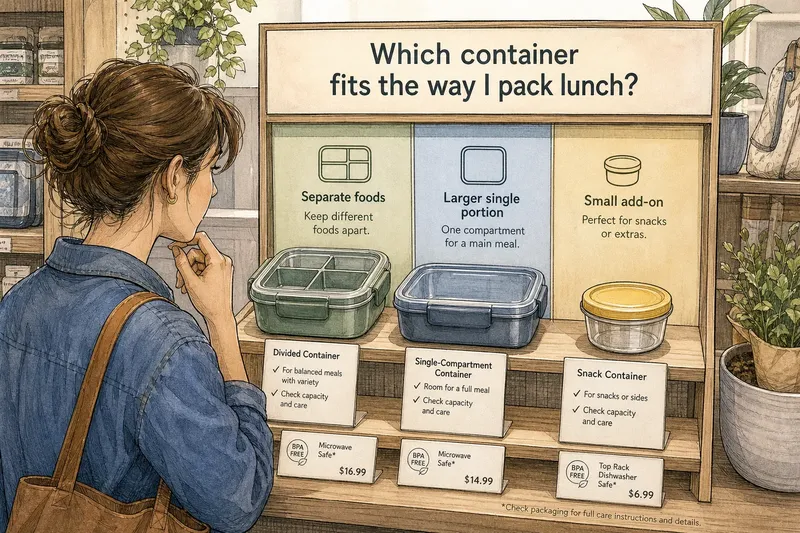
A customer looking at three kinds of lunch containers may be wondering, “Which one fits the way I pack lunch?” A product display built around that customer question can make the choice easier to compare without turning the shelf into a sales pitch. Start with the decision shoppers face, then show how each item differs.
This method is not mainly about arranging colors, adding props, or drawing the eye to a centerpiece. It is about making the comparison itself legible: what each option is for, what it asks the buyer to trade, and what facts still need checking on the product or its label.
Which customer question belongs on the display?
Look for a real point of comparison, not a broad theme. “What do I need for lunch?” may be too open-ended. “Which container suits a packed salad, a sandwich, or snacks on the go?” points toward distinct uses and makes room for honest differences.
Ask what a shopper needs to decide before choosing: intended use, format, material, compatibility, care, or portability. Then phrase the question in ordinary language. If the assortment cannot answer it clearly, choose a narrower question or a different group of products.
A good question does not imply that one item works for everyone. It helps shoppers identify what to compare, much like sorting mail into labeled trays: the labels guide the search, but each envelope still needs to be read.
How can the display show useful tradeoffs?
Give each product a clear place in the comparison. You might arrange items by use, closure style, material, or care instructions—whichever distinction matters to the customer’s decision. Keep the categories accurate, and avoid suggesting that a product has a feature unless its packaging or reliable product information confirms it.
Use short, specific prompts beside the items, such as “for loose snacks” or “check care instructions.” Keep actual product details, compatibility information, warnings, and prices with the relevant item. The question organizes browsing; it cannot replace those facts.
Say you have three lunch containers: a divided model, a single-compartment model, and a small snack tub. You place them in that order and add cards reading “separate foods,” “larger single portion,” and “small add-on.” A shopper can match the options to a planned lunch, then check each package for capacity, care, and other product details before deciding. The tradeoff is visible without claiming that one container is best for everyone.
What should you check before opening the display?
- Check the question against the assortment. If every item answers it in a distinct, truthful way, keep the wording; if not, narrow the question or remove unrelated products.
- Check that each comparison is supported by product information. If a feature is confirmed on the label or reliable product material, describe it plainly; if it is unclear, omit the claim and direct shoppers to the source details.
- Check whether each item’s intended role is understandable. If shoppers can distinguish the options from the item and its short prompt, retain the grouping; if not, revise the prompts or regroup by a clearer distinction.
- Check that essential details stay with the product. If prices, care notes, compatibility information, or warnings are easy to match to the correct item, leave them in place; if not, reposition or clarify them before opening.
- Check whether the comparison implies a universal winner. If the wording names a specific use or tradeoff, keep it; if it suggests one option suits everyone, rewrite it to describe the actual difference.
- Check the display from a shopper’s approach. If the question and product differences are readable without moving items, keep the arrangement; if not, adjust the placement or simplify the group.
What do shoppers often ask about a question-led display?
Can the display include products from different categories?
Yes, if they help answer the same specific customer question and their different roles are clear. If the connection needs a long explanation, split the group or make the question more precise.
How do I compare products with different features?
Choose one useful distinction at a time, such as intended use or care requirements, and state only details supported by product information. Keep other specifications available at each item so shoppers can check what matters to them.
Should the display name a recommended product?
Only if the recommendation has a clear, supportable basis and does not hide relevant tradeoffs. Often it is more helpful to show who each option may suit and let the shopper decide.
What if shoppers still need staff help?
That is not a failure: some decisions depend on details the display cannot show. Keep those details accessible, and make it easy for staff to explain the differences without contradicting the signs.
When should the customer question change?
Change the question when the products no longer answer it, when a better-supported distinction would help shoppers compare, or when the assortment shifts to a different use. Do not change it merely to make the display seem new; a useful comparison can remain relevant while the products and information stay accurate.
For a product display built around a customer question, the most useful final check is whether the sign helps someone choose what to investigate next. If it points to a real need, makes the differences honest, and leaves product-specific facts easy to verify, the display is doing its job without deciding for the shopper.